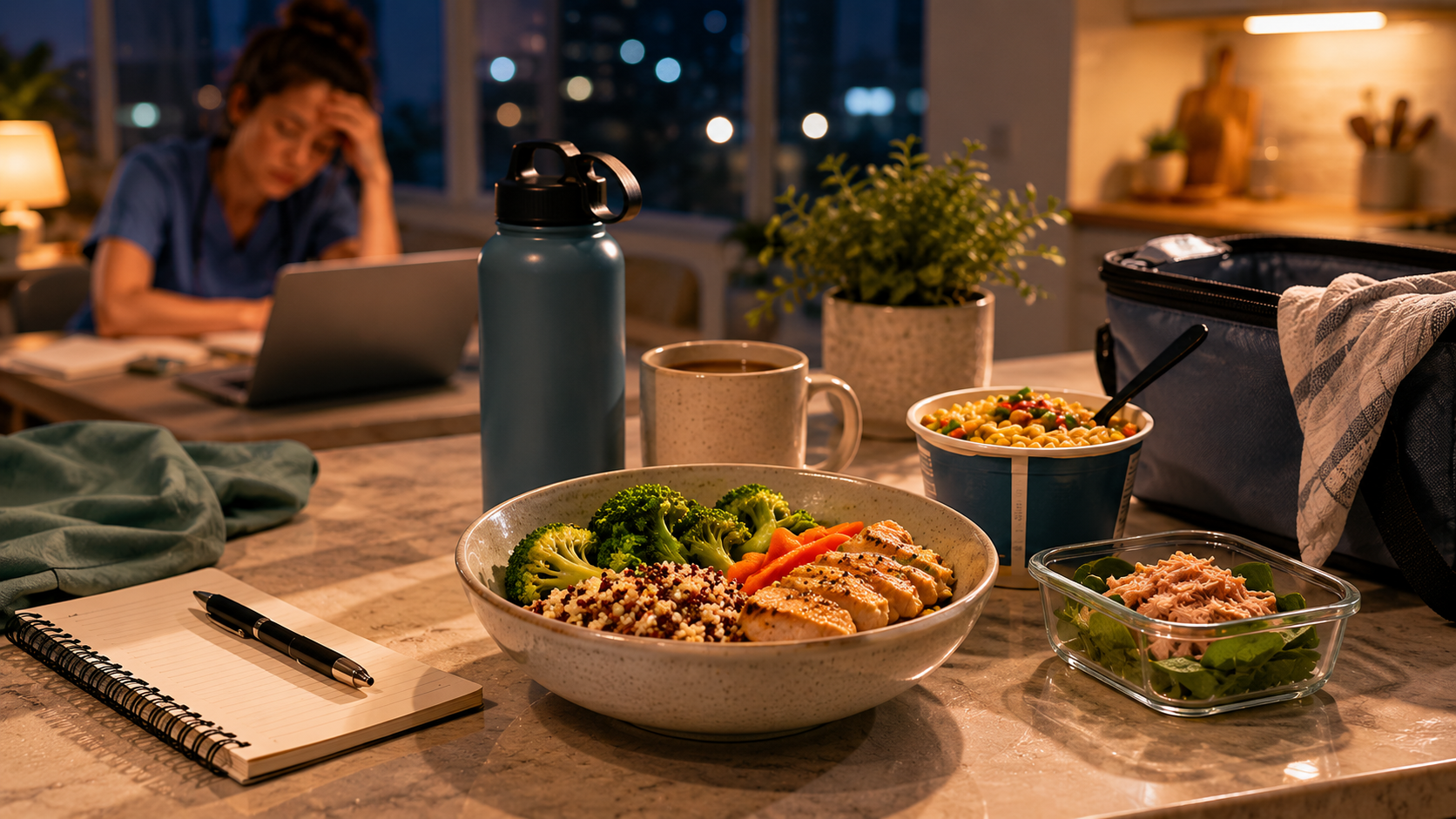
You worked a double. You got home after midnight. You grabbed fast food because nothing else was realistic, and now a small voice is telling you that you should have done better.
You do not need that voice right now. You need food, sleep, and a plan that works for the life you are actually living.
Most diabetes nutrition advice is written for people with time. When you are working back-to-back shifts or irregular hours, that advice does not apply. This post is not going to tell you to meal prep. It is going to tell you what to grab when you cannot.
What This Post Covers
- Why exhaustion raises blood sugar before you even eat
- Which convenience foods actually support blood sugar stability
- The one structural shift that changes your glucose response without cooking
What Exhaustion Does to Blood Sugar Before Food
Sleep deprivation and blood sugar have a direct physiological relationship most people are never told about.
When you are sleep-deprived, cortisol rises. Cortisol does two things that directly affect blood sugar:
- Signals the liver to release stored glucose into the bloodstream
- Reduces insulin sensitivity, making your cells less responsive to whatever insulin is available
Both effects raise blood sugar independently of anything you eat. Someone managing Type 2 diabetes starting the day on five hours of sleep is already managing elevated glucose and reduced insulin efficiency before their first meal.
The goal when exhausted is not better choices through willpower. It is making the convenient option a reasonable one.
Exhaustion also degrades prefrontal cortex function — the part of the brain that handles planning and impulse control. The brain shifts toward reward-seeking. Calorie-dense, processed food becomes disproportionately appealing. This is not a character flaw. It is neuroscience.
What Fast Food Does to Blood Sugar
The problem is not the occasional fast food meal. The problem is what happens when it becomes the default.
Most fast food is high in refined carbohydrates — white buns, fried coatings, large portions of white rice — that break down rapidly to glucose. It is low in fiber, with nothing to slow gastric emptying or buffer absorption. And it is high in saturated fat, which worsens insulin resistance over time.
The result: a significant post-meal glucose spike, followed by a drop that produces hunger again within one to two hours despite the high calorie load. The spike requires attention. The drop drives cravings. The cycle repeats on top of a body that is already depleted.
Convenience Foods That Actually Work
These are not perfect meals. They are better options for nights when cooking is not happening.
Protein cup noodles + frozen vegetables
Add frozen vegetables directly to the cup before hot water. The hot water thaws them as it cooks the noodles. Protein slows digestion. Vegetables add fiber. The blood sugar response is meaningfully different from plain noodles. Total time: under five minutes.
Pre-seasoned lentil packets over a quick-cooking grain blend
Lentils have a low glycemic index because of their combined fiber and protein content. A packet heats in under a minute. Served over a quinoa-rice blend, the meal delivers more protein and fiber than almost anything from a drive-through at the same time investment.
Canned salmon or tuna + whatever vegetables you have
One can provides 25 or more grams of protein. That level of protein supports satiety in a way that reduces the reach-for-more pattern that follows low-protein meals. No cooking. No cleanup beyond the can.
The One Structural Shift Worth Making
You do not need to count anything. You need to flip one ratio.
Most plates are built backward for blood sugar management: starch is the largest portion, protein is secondary, vegetables are the afterthought.
Most plates (backward)
- Starch — largest portion
- Protein — secondary
- Vegetables — afterthought
Flipped plate (better)
- Vegetables — largest portion
- Protein — second
- Starch — smallest portion
The same 30 grams of carbohydrate produces a different blood sugar curve depending on what surrounds it. When protein and fiber precede and accompany carbohydrate digestion, absorption slows and the glucose rise is lower and more gradual.
When eating out, protein is easy to find. Vegetables are the hard part. That is the one thing worth actively looking for when you are too tired to think about everything else.
The Appliance Worth Fifteen Dollars
A personal hot pot or small crock pot costs between $15 and $30 — the same as two or three drive-through meals — and lasts a year.
“The barrier to eating something nourishing during a long shift is usually not desire. It is the absence of a way to heat real food.”
Protein noodles with broth and frozen vegetables. Soup kept warm through a shift. An egg scrambled before leaving the house. No cooking skill required.
What You Can Do
Keep protein cup noodles and frozen vegetables at home and at work
Hot water does the cooking. Add vegetables before the water goes in.
Pick up pre-seasoned lentil packets and a quick-cooking grain blend
Two minutes. More nutrition than a drive-through.
Rebuild your plate proportion
Vegetables first, protein second, starch smallest. No counting needed.
Consider a small hot pot for work
It costs less than three meals out. It removes the main barrier to eating something real during a long shift.
Stop treating fast food as a failure
If it is happening regularly, the solution is making something better equally accessible — not finding more willpower.
When to Get Help
If your schedule makes consistent meals genuinely difficult and your blood sugar is reflecting that, a registered dietitian who understands busy and unpredictable lifestyles can help you build something realistic. Not a perfect plan. One for the life you are actually living.