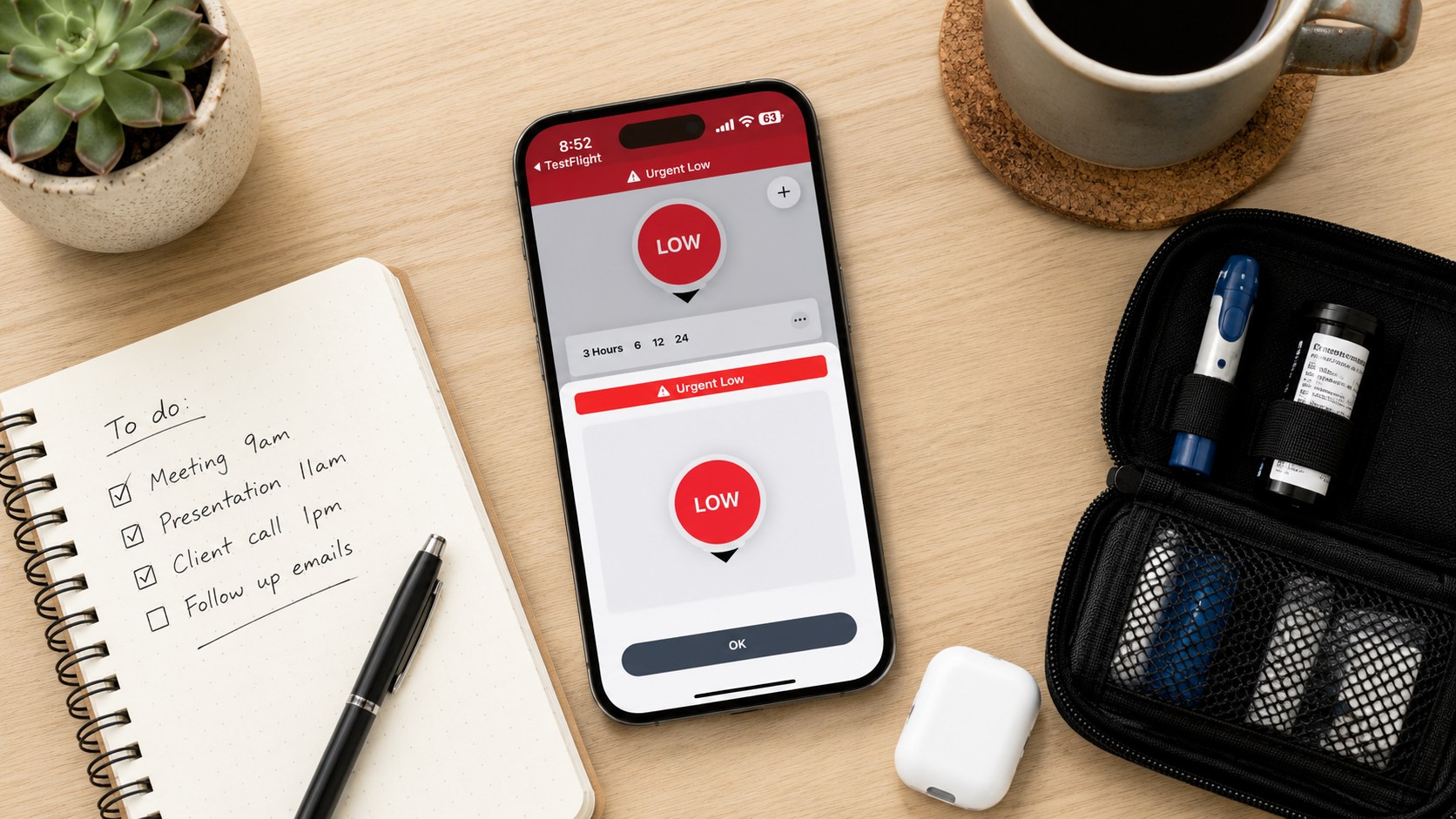
It is a typical workday. Your CGM buzzes, telling you your blood sugar is dropping. You are in the 80s, the arrow is pointing down, and panic starts to settle in. Maybe you are leading a class, stuck in a meeting you cannot leave, or driving with no stop in sight. That urgent, sinking feeling kicks you into high gear. You pause your pump, switch to activity mode, or do everything you can think of to stop the low from happening.
But the low happens anyway. Then it is followed by a rebound high. And this frustrating rollercoaster repeats itself.
If this sounds familiar, you are not alone. This is not a "you should manage better" moment. What you are experiencing is totally normal and tied to a very real fear of low blood sugar. And the good news? There are better ways to handle this than constantly fighting a losing battle.
What This Post Covers
- Why fear of hypoglycemia (FOHY) is a recognized clinical pattern — and how it quietly drives glucose instability
- Why pausing the pump and activity mode do not stop an in-progress low
- How time-based pump settings create a structural buffer that works automatically
Fear of Hypoglycemia Is Real
Being afraid of low blood sugar is not irrational. Severe lows can be dangerous, leading to confusion, seizures, or unconsciousness. And this fear can quietly mess with your overall glucose control.
Researchers even have a name for it: fear of hypoglycemia, or FOHY. It is not just general anxiety — it is a specific reaction to the danger lows can cause, especially after scary episodes in the past.
Because lows feel dangerous, you might find yourself doing things to avoid them:
- Keeping blood sugar higher than usual as a safety net
- Eating extra snacks before tough moments, just in case
- Relying on pump features like activity mode in ways that unintentionally raise numbers
These actions are rational. They feel like they are keeping you safer. But over time they can create what is called protective hyperglycemia — where blood sugar stays consistently higher than it should because of these habits.
When these actions seem to work, your brain says, "Great! Do more of this." Even if they did not actually solve the problem, the relief you feel reinforces the habit. And so the cycle continues.
Why Pausing the Pump and Activity Mode Do Not Work
When you spot that downward arrow and jump into action, pausing the pump or switching to activity mode might seem like the answer. But these tools do not work the way we hope they will.
Pausing the pump: The insulin dropping your glucose right now was delivered 1 to 1.5 hours ago — not what you are receiving now. When you pause your pump at the moment you see the downward arrow, you are stopping insulin that would affect your blood sugar 1 to 1.5 hours later. This means there is nothing to cover the rebound after the low resolves. The result is often a frustrating high.
Activity mode: In most insulin pumps, activity mode increases your glucose target to around 150 mg/dL and assumes physical movement will bring levels down. If you are not moving — in a meeting, driving, standing at a whiteboard — the algorithm does not know that. It still delivers less insulin based on the mistaken assumption that activity is lowering your blood sugar.
“Both interventions feel like immediate fixes, but neither addresses the root cause — and both create glucose instability rather than resolving it.”
Why Time-Based Pump Settings Actually Work
Instead of trying to out-think low blood sugar in the heat of the moment, you can set up your pump to do the work for you automatically. This approach uses time-based structural settings to create a safe buffer during your work hours.
Two settings make this possible:
Target Glucose
Tells the pump the blood sugar level it should aim to maintain. Setting this slightly higher during work hours gives your blood sugar room to move without triggering a correction.
Correct-Above Threshold
Sets the point at which the pump starts delivering extra insulin to bring high glucose back down. Widening the gap between this and your target creates a buffer zone.
When these two settings are set too close together — say, both at 120 mg/dL — the pump starts correcting as soon as glucose goes slightly over 120. That can quickly lead to lows during unpredictable work situations.
When you separate them (for example, target at 130 and correct-above at 140), your blood sugar gets a buffer zone. The pump does not try to correct a tiny rise to 125. It only delivers extra insulin if glucose reaches 140 or higher. Blood sugar within the 115–130 range stays steady, without alarms or corrections that might throw things off.
You can program these settings specifically for your work hours while leaving tighter settings for evenings or nights.
What You Can Do
Stop relying on pausing the pump or activity mode during drops
Neither stops already-active insulin. Instead, treat lows with fast glucose like tablets, and allow your pump's algorithm to correct naturally.
Talk to your care team about time-based settings
Request specific adjustments like a higher glucose target or a wider correct-above threshold for stressful work hours.
Know that relief does not always mean success
It might feel like activity mode prevented a low, but it did not. The low may not have happened anyway — and the rebound high it creates is the real cost.
Use activity mode only for actual exercise
Apply it 15–20 minutes before light activity or 30–60 minutes before a workout. Not for meetings, driving, or standing.
Give new settings at least two to three weeks before evaluating
Avoid making manual changes too soon. Premature overrides can confuse the pump's algorithm and delay the pattern stabilizing.
When to Get Help
If your fear of lows is interfering with work, sleep, or everyday life, it is worth reaching out for support. No pump setting or algorithm can fix this alone — and that is okay. A certified diabetes care and education specialist can review your data, help with structural adjustments, and work with you on strategies to shift behavioral patterns that have built up over time.
Fear is natural, but it does not have to keep running the show.