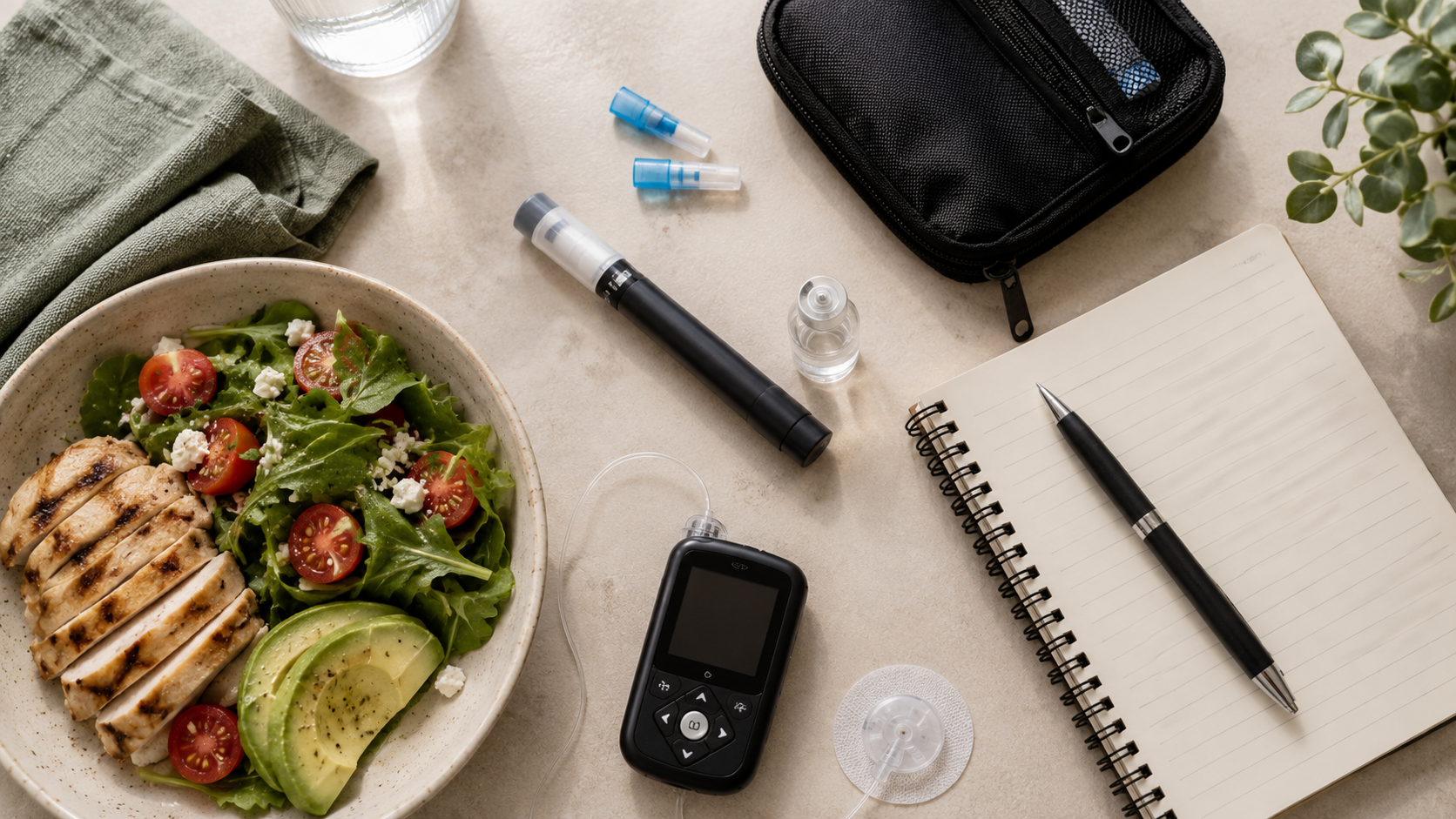
You sit down to eat, take a few bites, and then remember you were supposed to dose fifteen minutes ago. So you bolus now, watch your blood sugar climb past 200, and spend the next two hours chasing it back down.
This happens to almost everyone managing Type 1 diabetes. And it will keep happening if the solution being suggested requires something your life does not reliably have: fifteen uninterrupted minutes between deciding to eat and actually eating.
What This Post Covers
- Why the 15-minute pre-bolus rule is genuinely hard to follow — and not just a willpower problem
- What late bolusing does to your blood sugar pattern and why it is hard to troubleshoot
- What your realistic options are, including one that removes the timing problem almost entirely
Why the 15-Minute Window Is So Hard to Hit
Standard guidance for fast-acting insulins like Novolog and Humalog recommends dosing fifteen minutes before eating. The biology behind it is straightforward:
| Phase | Timeline |
|---|---|
| Insulin onset (begins working) | ~15 minutes after injection |
| Insulin peak activity | 60 to 90 minutes after injection |
| Insulin duration time | 3–5 hours after injecting |
| Carbohydrate absorption begins | Within minutes of eating |
When timed well, insulin and blood sugar arrive together. The blood sugar rising from the meal meets insulin that is just becoming active. Blood sugar rises modestly and comes back down smoothly within 3–5 hours.
When insulin arrives late, blood sugar gets a significant head start. Blood sugar climbs before any meaningful insulin is working. By the time the insulin peaks, it is chasing a number that has already moved well above target.
The fifteen-minute pre-bolus rule assumes you can stop, dose, and wait before every meal. That is a reasonable ask in some situations. It is genuinely not reasonable in a warehouse, on a job site, in a school cafeteria with a fixed lunch window, at a restaurant where food arrives unpredictably, or just in ordinary life where meals are not always planned events.
Forgetting consistently is not a character flaw. It is a mismatch between the tool and your life.
What Late Bolusing Does to Your Blood Sugar Pattern
The pattern that late bolusing produces is specific and predictable — and easy to misread as a dose problem rather than a timing problem.
- Blood sugar spikes sharply in the window when insulin is not yet active
- By the time insulin begins working, the rise may already be at 220, 250, or higher
- Insulin then lowers blood sugar, often dramatically, because the bolus calculator now accounts for both the elevated blood sugar and the carbs, rather than the lower starting level before eating
The dose could be exactly right. The roller coaster is not about the amount of insulin. It is purely about sequence. Blood sugar and insulin are arriving in the wrong order.
This pattern is also harder to troubleshoot because the spike happens early and the correction happens hours later, making it easy to blame the meal or the dose rather than recognizing that timing is the actual variable.
The Option That Removes the Timing Problem
Fiasp or Lyumjev is a faster-acting formulation of insulin that begins working in approximately two minutes rather than fifteen.
It was developed specifically to close the gap between when people actually eat and when insulin needs to be active.
With a two-minute onset, the pre-bolus requirement essentially disappears. You make your plate, give the insulin, sit down, and start eating. The insulin is working by the time the first bites are digested. No waiting. No planning ahead. No fifteen-minute window.
For people whose post-meal spikes are primarily a timing problem rather than a dosing problem, Fiasp or Lyumjev changes the pattern without requiring any change in habits or behavior. The insulin simply matches real-world eating pace better.
“Are my post-meal spikes happening because the dose is wrong, or because the insulin is arriving too late to do its job?”
A question worth bringing to your endocrinologist.
If Switching Insulins Is Not an Option Right Now
Insurance coverage, formulary restrictions, or your doctor's preference may mean staying on your current insulin. There are still adjustments that reduce the impact of late bolusing.
Partial bolus strategy: Instead of waiting until after you eat, try bolusing for about 50–75% of the expected carbs before your meal. Once you have a clearer idea of how much you are actually eating, cover the rest during the meal. Some insulin on board before carbohydrates are absorbed is meaningfully better than none.
Honest timing calibration: Tell your care team your actual bolusing timing. Insulin pump settings are calibrated around a fifteen-minute pre-bolus assumption and will perform differently when the actual lead time is zero. Adjusting the settings to reflect your real-world timing produces more accurate dosing than trying to match settings designed for a behavior that is not actually happening.
What You Can Do
Ask your endocrinologist about Fiasp or Lyumjev
Explain that you are consistently bolusing at mealtime rather than before it and ask whether a two-minute onset insulin fits your situation.
Use a partial bolus strategy if you stay on your current insulin
Half the expected dose before the first bite, the remainder shortly into the meal. Some insulin ahead of the food is always better than none.
Tell your care team your actual bolusing timing
Honest reporting allows your settings to be calibrated for reality rather than an idealized pattern that is not actually happening.
Set a reminder fifteen minutes before your typical meal times
The goal is not perfect pre-bolusing every time. It is reducing the gap from zero to something small.
Track your two-hour post-meal blood sugar for one to two weeks
Repeated spikes above 200 despite appropriate doses point to timing as the primary variable.
When to Get Help
If you are dealing with consistent post-meal spikes and have not specifically discussed bolus timing and insulin type with your care team, that conversation is worth having. A certified diabetes care and education specialist can review your CGM data alongside your dosing timing to identify whether this is a timing problem, a dosing problem, or both.