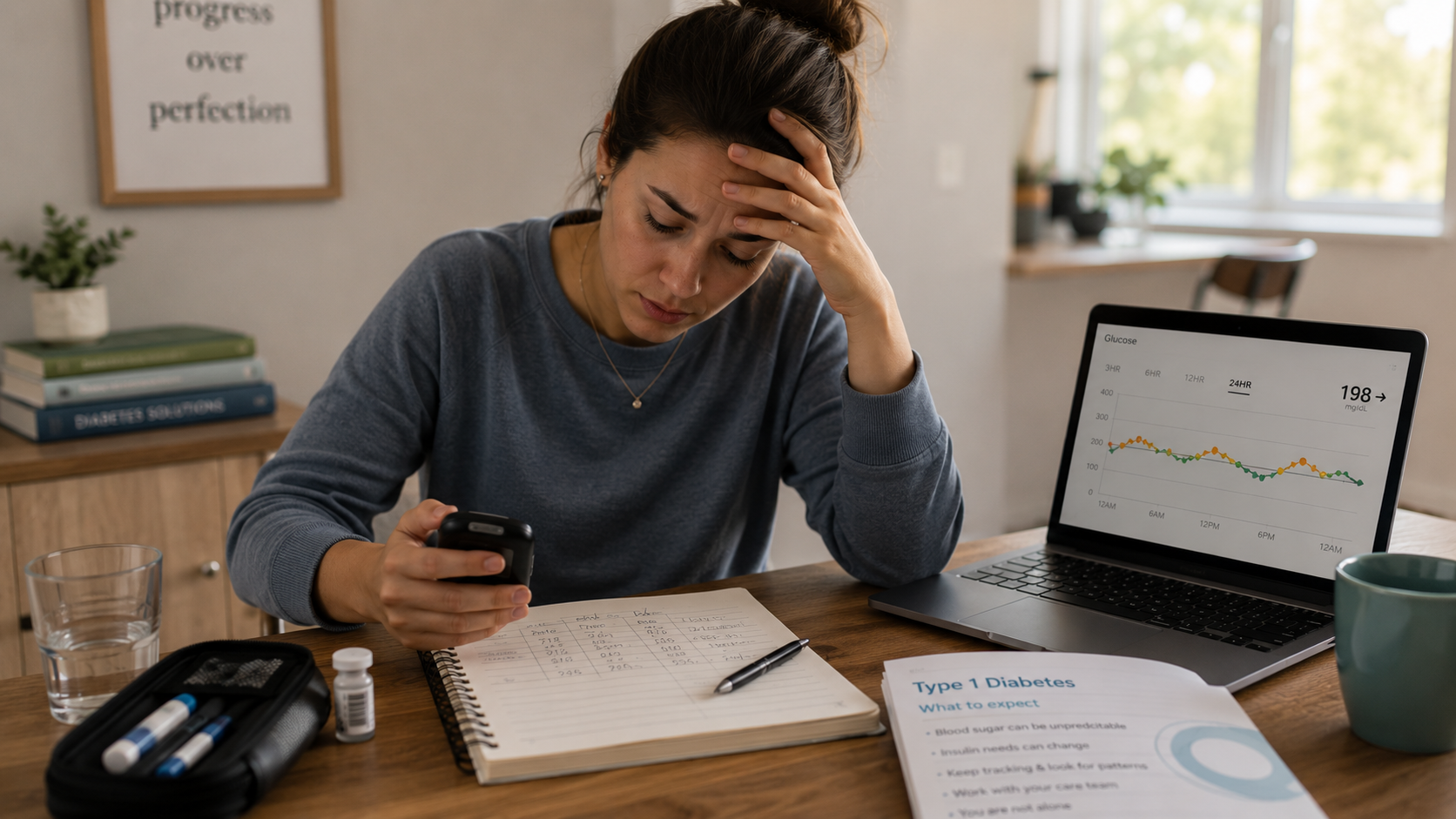
You were just diagnosed with Type 1 diabetes. You started insulin. You expected things to stabilize. Instead, your blood sugar is swinging in ways that do not match what you ate or how much insulin you took. Some days your doses work. Other days the same dose sends you low. You are doing everything right and it still does not make sense.
There is a name for this stage. It is called the honeymoon phase, and despite the name, it is one of the most confusing stretches in early Type 1 diabetes management.
What This Post Covers
- What the honeymoon phase is and why it makes blood sugar unpredictable
- How long it typically lasts and what signals the end of it
- What to do during this period so you are not constantly chasing numbers
What the Honeymoon Phase Actually Is
When you are first diagnosed with Type 1 diabetes, your immune system has been attacking the insulin-producing beta cells in your pancreas. But that process does not happen all at once.
At diagnosis, some beta cells are still surviving and still producing insulin on their own. Starting external insulin also reduces the metabolic stress on those remaining cells, which can allow some of them to temporarily recover and produce more insulin than they were producing right before diagnosis.
This is why the weeks or months following a Type 1 diagnosis often bring a period of relative stability. Insulin needs drop. Numbers settle. Some people need very little external insulin for a stretch.
That is the honeymoon phase. It is real, it is common, and it is temporary.
Why It Makes Blood Sugar So Unpredictable
The challenge is that your pancreas is contributing an inconsistent, unmeasurable amount of insulin on top of whatever you are injecting or pumping. You have no way to know how much it will add on any given day.
What this looks like in practice:
- Some days the pancreas contributes more — the combination of its insulin and yours pushes blood sugar lower than expected
- You treat the low
- The next day the pancreas contributes less — the same dose is suddenly not enough
- Numbers climb
This is not a management error. It reflects a system with an uncontrollable variable — your pancreas — operating on its own unpredictable timeline. The same meal, the same dose, different results. Not because you did anything differently. Because the invisible variable changed.
How Long It Lasts
There is no reliable way to predict duration. Some people experience the honeymoon phase for a few weeks. Others remain in it for a year or more.
What typically signals the end:
- Doses that were working start feeling insufficient
- Blood sugar runs higher more consistently, particularly overnight and in the morning
- The unpredictability of earlier days resolves into a more stable but higher baseline
This transition is not a sign that something went wrong. It is the natural progression as the remaining beta cells stop functioning. At this point, blood sugar management often becomes more predictable, not less — because the pancreas is no longer adding an uncontrolled variable. You are working only with the insulin you deliver, and doses can be calibrated accurately.
As the honeymoon phase ends, your total daily insulin requirement will increase. This is expected and does not mean your diabetes is worsening. It means your body has transitioned to full dependence on external insulin, which is what Type 1 always involves.
“Single data points during the honeymoon phase are nearly impossible to interpret accurately. Patterns across weeks are meaningful.”
Why Chasing Perfect Numbers Makes This Period Harder
The most common source of frustration during the honeymoon phase is making frequent dose adjustments based on individual days.
The problem: Every adjustment you make is interacting with the pancreas variable you cannot see. A dose that seems too low today may cause a low tomorrow because your pancreas happened to contribute more. You cannot distinguish your adjustment's effect from your pancreas's contribution.
What actually helps:
- Set conservative starting doses that prioritize avoiding lows over perfect numbers
- Look for patterns that repeat across at least one to two weeks before concluding a setting needs to change
- Give any adjustment at least two weeks before evaluating whether it helped
- Use CGM trend data over multiple days, not individual readings, as your primary reference
What You Can Do
Prioritize avoiding lows over precision
Work with your care team to set conservative starting doses. Safety during this period matters more than tight control.
Do not adjust doses based on single days
The pancreas variable makes day-to-day data unreliable. Wait for a pattern that repeats over at least a week.
Keep a record
Meals, bolus timing, activity, and glucose response. This data makes the honeymoon phase navigable when reviewed with a specialist.
Give adjustments two full weeks before evaluating
Changing settings more frequently makes it impossible to know what is actually helping.
Be patient with yourself
Blood sugar variability during this period is a feature of the biology. It is not a reflection of how well you are managing.
When to Get Help
If you are newly diagnosed with Type 1 diabetes and struggling to make sense of your blood sugar patterns during the honeymoon phase, the team at Balance Diabetes Wellness specializes in exactly this. Understanding what you can and cannot control right now changes how you relate to the numbers you are seeing — and having someone in your corner during this period makes a real difference.