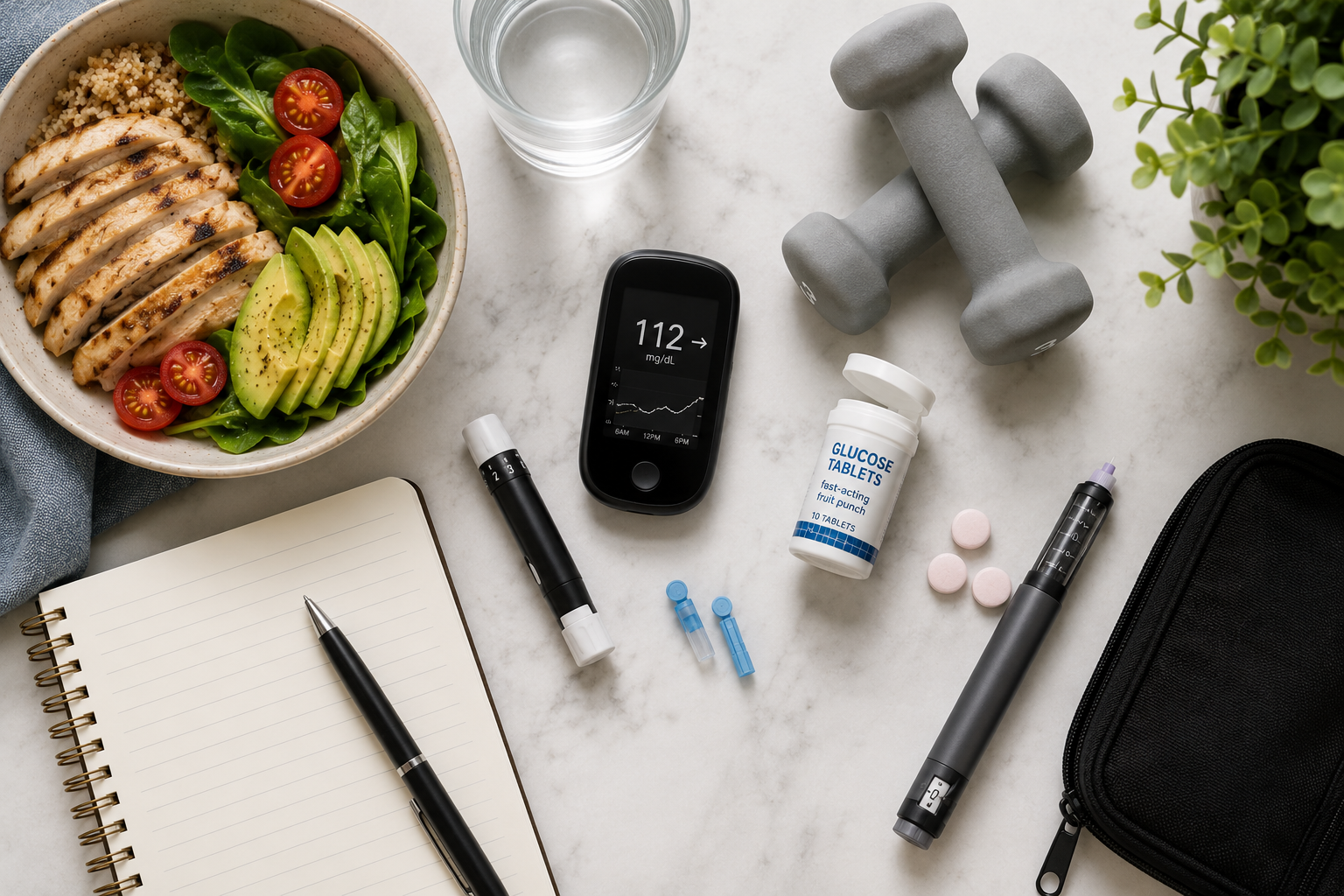
You eat well. You are active. You are making thoughtful choices. And the scale is not moving the way it should.
If you manage Type 1 diabetes with insulin, there is one factor in your weight equation that almost nobody addresses directly. It has nothing to do with your meals or your exercise. It has to do with what you are eating to treat your low blood sugars — and why the standard treatments make the problem worse than it needs to be.
What This Post Covers
- Why insulin itself creates a biological environment that makes fat loss harder
- The calorie math of treating lows that most people have never calculated
- Why candy is a pharmacologically poor choice for treating hypoglycemia
- How glucose tablets change both the absorption timeline and the calorie cost
Insulin Is a Fat-Storage Hormone
Before getting into low treatment strategies, it is worth understanding something about insulin that shapes the entire weight loss conversation for Type 1 patients.
Insulin does not only move blood sugar into cells for energy. It also signals fat cells to store fat and suppresses the release of stored fat for fuel. When insulin levels are high, the body's ability to burn fat is essentially paused.
People without diabetes benefit from tight, precise insulin responses. Their pancreas releases exactly what is needed, peaks quickly, and clears quickly. People managing Type 1 externally are working with a much less precise system. Subcutaneous insulin injection produces a slower, blunter curve that keeps insulin levels elevated longer than a natural pancreatic response would.
This is not a solvable problem with current technology. But understanding it removes self-blame and makes the real leverage points — like low treatment strategy — even more important.
The Calorie Math Nobody Calculates
Treating one to two lows per day is not unusual for someone managing Type 1. Most people have never asked themselves: what does that cost in calories across a week?
At one to two lows per day treated with juice or candy, the weekly calorie addition from low treatments alone is 700 to 3,500 calories — enough to maintain nearly a pound of body fat per week entirely from medical necessity, with zero connection to food choices.
This is the arithmetic that explains why patients who are eating correctly, exercising, and tracking carefully still cannot move the scale. The caloric deficit they are creating through diet is being partially or fully erased by the calories required to stay safe.
“Switching from candy to glucose tablets for one to two daily lows saves 600 to 1,300 calories per week from the treatment method alone — before any changes to diet or exercise.”
Why Chocolate and Candy Are a Poor Clinical Choice
Fat slows gastric emptying. Any low treatment with significant fat content — chocolate, peanut butter cups, wax-coated gummies — produces a correction that lags further behind the low than juice does.
The experience: you eat, nothing seems to be happening, anxiety escalates, you eat more. When the correction finally arrives, it arrives on top of significant overconsumption. The rebound high is often worse than the original low. Additional insulin follows. Another low is possible hours later.
Fat-containing foods are among the worst possible choices for acute hypoglycemia treatment from both a speed and a calorie efficiency standpoint.
What Glucose Tablets Do Differently
Pure glucose tablets can start absorbing through the oral mucosa and buccal tissue directly into the bloodstream — a fundamentally different absorption route from anything requiring gastric processing.
The correction begins before you finish chewing. Within one to two minutes of a glucose tablet dissolving in your mouth, blood glucose is measurably rising. This is not perception. The pharmacokinetics are genuinely different from any gastric-dependent treatment.
This speed changes behavior. When you know the correction has already started, you are far more likely to stop at the clinically appropriate amount rather than continuing to eat because nothing seems to be working. That behavioral shift alone meaningfully reduces overcorrection and rebound.
- Each glucose tablet: 4 grams of carbohydrate, approximately 16 calories
- A blood sugar of 68 with a flat arrow requires a different correction than 58 with a downward arrow — glucose tablets let you make that distinction with precision
- Weekly calorie difference: switching from candy to glucose tablets saves 600 to 1,300 calories per week from low treatments alone
What You Can Do
Switch to glucose tablets as your primary low treatment
Sublingual absorption eliminates the correction delay that causes overconsumption, and the 16-calorie-per-tablet count gives you precise control.
Calculate your actual weekly calorie contribution from low treatments
The number is almost always higher than expected and often directly explains a weight plateau.
If you are having more than one low per day, talk to your care team
Frequent lows are almost always a settings or dosing issue that is solvable.
Keep glucose tablets in multiple locations
The high-calorie option wins by default when it is the only thing within reach.
When to Get Help
If you have been managing Type 1 for years and nobody has ever walked you through the calorie math of low treatment, or connected your bolusing habits to your low frequency, that conversation is worth having. These are solvable problems with targeted solutions that do not require eating less or exercising more.